Why Your Voice Changes When You’re Nervous (And How to Regain Control)
If you’ve ever stepped onto a stage, opened your mouth to sing or speak, and suddenly thought, “Why does my voice feel so different right now?” — you’re not imagining things.
Your voice might sound higher, thinner, shakier, or less reliable than it did just minutes earlier during practice. This can even happen when you’re about to record yourself. Simply knowing that someone might listen to your voice later can trigger the same response as standing in front of an audience.
Notes that felt easy suddenly feel out of reach. Your breath shortens. Your throat tightens. And a familiar question appears:
Why does my voice get higher when I’m nervous?
This experience is incredibly common — not just for beginners, but for seasoned singers, speakers, and performers alike. Performance anxiety doesn’t mean you’re unprepared, untalented, or “bad with nerves.” It simply means your nervous system is doing exactly what it evolved to do: respond to situations that feel important, exposed, or high-stakes.
The voice is especially sensitive to this response because it sits at the crossroads of body, breath, and emotion. When something matters, your system reacts — quickly and instinctively.
The reassuring part is this: the more you understand what’s happening inside your body, the less overwhelming it becomes. Awareness creates choice. And choice makes regulation possible. Over time, that understanding allows you to recognize the signs earlier, respond more proactive, and find your way back to your voice more easily when nerves arise.
Therefore, in this article, we’ll look in to how to work with your nervous system — not against it. We’ll explore:
What actually happens to your voice when performance anxiety kicks in
How stress affects pitch, tone, and resonance
Why voice shaking is a biological response, not a personal failure
Practical ways to regain control — without fighting your body
A mindset shift that can transform how you experience live performance

Performance anxiety isn’t a sign that something is wrong — it’s a sign that your body is alive, alert, and responding to what matters.
PERFORMANCE ANXIETY AND THE VOICE: WHAT’S REALLY GOING ON?
Performance anxiety voice issues don’t come from nowhere. They’re rooted in biology. When you’re about to perform, your body may interpret the situation as high stakes. Your nervous system activates the fight-or-flight response, releasing adrenaline and cortisol into your bloodstream. This has several effects on your voice:
1. TENSION IN THE VOCAL MECHANISM
When adrenaline floods your system, your body prepares for action. Muscles throughout the body subtly contract, ready to move or protect you. Unfortunately, this response doesn’t skip the areas involved in voice production.
Tension often shows up in:
The jaw, which may clench or lock
The neck and shoulders, which can tighten and restrict airflow
The tongue, which may pull back or stiffen
The larynx, which can become less mobile
All of these responses will affect the sound of your voice.
You can think of it like trying to play a delicate guitar while wearing thick gloves. The instrument hasn’t changed — and your skill hasn’t disappeared — but the conditions make fine control more difficult.
When under the flight-or-flight response, vocal cords themselves may press together more firmly or lose some of their natural elasticity. This makes fine motor control harder, meaning:
Soft dynamics feel unstable
High notes require more effort
Transitions between notes feel less smooth
You’re not suddenly “worse” at singing or speaking — your voice is simply operating under tighter physical conditions than usual. And just like removing the gloves restores dexterity, calming the nervous system restores vocal freedom.
2. FASTER, SHALLOWER BREATHING
Breath is the fuel for your voice, and stress changes how you breathe almost instantly.
Under calm conditions, breathing is deep and efficient, supported by the diaphragm and lower ribs. Under stress, however, the body switches to quick, shallow chest breathing — a survival pattern designed for speed, not sound. This has several effects on your voice:
Less air available to sustain notes or phrases
Inconsistent airflow, which affects pitch and tone
A feeling of “running out of breath” sooner than expected
Because your voice depends on steady airflow, even subtle changes in breathing can make your sound feel unstable or unpredictable. This is often why singers feel like their voice is “not cooperating” when nerves hit — the foundation underneath the sound has changed.
3. RAISED LARYNX, HIGHER PITCH
This brings us to one of the most common questions performers ask: Why does my voice get higher when I’m nervous?
At the center of this response is the larynx, also known as the voice box. The larynx is a small but powerful structure made of cartilage and muscle, located in the front of your neck. It houses your vocal cords and plays a crucial role in how your voice is produced, shaped, and amplified.
You can easily feel your larynx yourself. Gently place your fingers on the front of your throat and swallow — you’ll notice a small structure moving up and down. That movement you feel is your larynx. It’s designed to be mobile, constantly adjusting as you speak, sing, breathe, and swallow.
When your nervous system is activated — for example, right before a performance — the larynx often lifts slightly. This happens unconsciously as part of the body’s alert response, without any deliberate choice on your part.
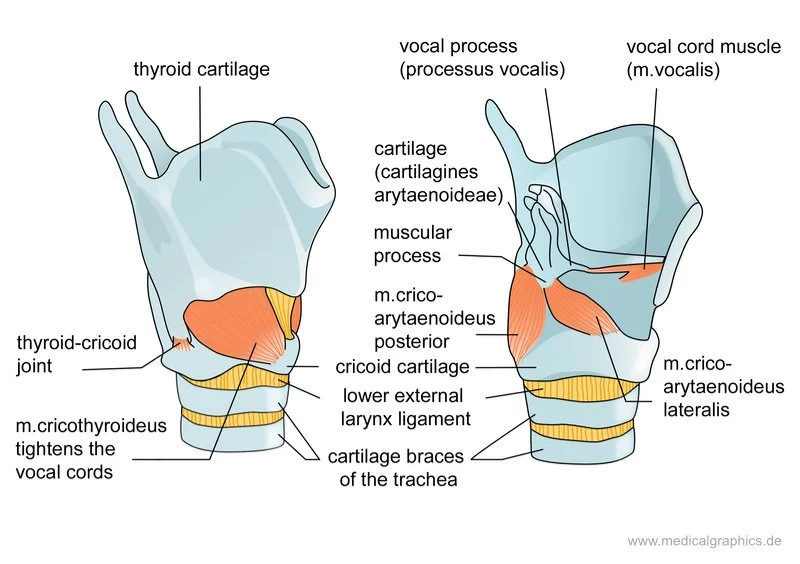
Source: MedicalGraphics.de – License: CC BY-ND 4.0
A helpful way to imagine this is to think of a flute. When you shorten the length of the flute by covering fewer holes, the pitch rises and the tone becomes brighter. The instrument itself hasn’t changed — only the space the air moves through has.
The same thing happens in your voice.
A raised larynx:
Shortens the vocal tract
Changes resonance space
Alters how sound is amplified
As a result, the voice may sound:
Higher than usual
Thinner or brighter
More strained, especially on sustained notes
This isn’t a technical failure or a lack of training — it’s a reflexive response to stress. Your voice is adapting to perceived urgency, not trying to sabotage you.
4. TREMBLING OR SHAKING VOICE
A shaking or trembling voice during performance can feel especially alarming, but it’s also one of the most misunderstood symptoms of performance anxiety.
Voice shaking usually comes from a combination of:
Adrenaline, which increases muscle activation
Irregular airflow, caused by disrupted breathing
Over-engaged muscles, trying to hold the voice “in place”
When your body senses uncertainty, it often tries to control harder. Ironically, this extra effort creates more instability, not less.
That’s why, if you’ve been searching for how to stop voice shaking during a performance, the answer isn’t to grip the sound more tightly — it’s to allow the system to regulate.
Stability returns when:
Breath slows down
Muscles soften
The nervous system feels a little safer
Your voice steadies not through force, but through better regulation.

Feeling safe on stage, starts with feeling safe within yourself.
Your inner dialogue can either support your voice or sabotage it.
Your Thoughts Are Part of Your Voice:
Why Mindset Matters for Performance Anxiety
So far in this article, we’ve explored the body-level connection — how adrenaline, tension, and larynx movement can make your voice feel higher, thinner, or less stable. Understanding what’s happening anatomically is a crucial first step. But it’s only half the solution. The next part lies in the mental aspect: your thoughts and beliefs have a direct impact on your voice.
Your inner dialogue can either support your voice or sabotage it. Practicing a supportive mindset — becoming aware of your own “inner failure culture” and how you perceive imperfection — is incredibly helpful. When those mental judgments inevitably arise during a performance, you can recognize them earlier. Awareness is key: it allows you to step out of the fight-or-flight response and, in the long run, prevent it from taking hold at all.
Feeling safe on stage begins with feeling safe within yourself. I cannot emphasize this enough. Sharing these experiences with other musicians — the common mental challenges around sharing your music, your voice, your art — can be transformative. (That’s exactly why I created The Music Room: a space where performers can openly explore these mental blocks without judgment.)
One of the most frustrating things about performance anxiety is that the more you try to “fix” your voice in the moment, the less cooperative it becomes. That’s because:
Your body is already in a state of alert
Forcing control adds more tension
Tension further disrupts breath and resonance
Your voice doesn’t need to be dominated — it needs to feel safe. Regaining control starts not with correcting the sound, but with calming the nervous system. Once your mind and body feel safe, your voice naturally follows.

You’re not getting worse — your voice is just working under tighter conditions.
Therefore the key to handling performance anxiety is not trying to control your voice harder – but creating a feeling of safety within yourself, which supports nervous system regulation.
Step 1 – Build Safety Before You Step on Stage
Performance anxiety doesn’t start on stage — and it can’t be solved there either. The more safety and familiarity you build before a performance, the less your nervous system needs to go into fight-or-flight once the spotlight hits.
Here are a few ways singers and musicians can create that sense of internal grounding in advance:
1. PRACTICE WITH INTENTION, NOT JUST REPETITION
Thorough preparation isn’t about perfection — it’s about familiarity. When your body knows the material deeply, it has something solid to fall back on even when nerves appear. Practice until the music feels embodied, not just memorized.
A good indicator that you truly know a piece is this: you can recall the lyrics while making coffee in the morning. When you’re able to multitask and still get everything right, it means the mental effort required to access the material is low — and that’s exactly what you want before a performance.
Sometimes I even practice singing while other music or the news is playing in the background. If you can stay oriented in the song despite distractions, your brain and body have learned it well enough to hold steady under pressure. On stage, where adrenaline and sensory input are high, this kind of preparation makes a real difference.
2. ESTABLISH A RELIABLE WARM-UP ROUTINE
Give yourself enough time before the gig to connect with your voice. A consistent warm-up routine becomes an anchor: your body learns, this is the moment where things settle. Over time, your nervous system associates these exercises with safety and readiness — not pressure.
Gentle coordination-focused warm-ups, like moving through scales with lip trills, help your vocal cords come together efficiently without force, reducing the urge to push when adrenaline is high.
3. USE SUPPORTIVE SELF-TALK
What you say to yourself before a performance matters more than most musicians realize. Your inner dialogue directly affects how safe your nervous system feels — and that safety shows up in your voice, your timing, and your ability to stay present.
When internal pressure takes over, the mind often defaults to threat-based thoughts: Don’t mess this up. Everyone will notice if you fail. This has to be perfect. Even if these thoughts feel automatic, they signal danger to the body — which increases tension, shallow breathing, and performance anxiety.
Consciously replacing them with grounding reminders can shift that response. Simple statements like I’ve done this before, My body knows this music, or My job is to express, not to impress help redirect your focus away from evaluation and back toward experience.
This isn’t about forced positivity or pretending you’re not nervous. It’s about offering your nervous system a more accurate message: I am capable. I am prepared. I am allowed to be here.
Over time, practicing supportive self-talk before performances trains your system to associate being on stage with familiarity rather than threat — and that alone can significantly reduce performance anxiety.
4. CREATE A SIMPLE PRE-PERFORMACE RITUAL
This routine doesn’t have to be elaborate. It can be as simple as drinking a cup of tea (not too hot), doing a few gentle stretches, humming softly, or taking a handful of slow, quiet breaths. What matters isn’t what you do — it’s that you do it consistently.
The point isn’t superstition or ritual for ritual’s sake. It’s predictability. When you repeat the same small actions before each performance, your nervous system begins to recognize the pattern and responds with a sense of familiarity rather than alarm.
Over time, these cues tell your body: I’ve been here before. I know what’s coming. I can handle this. That feeling of internal safety can make a noticeable difference in how your voice responds once you’re on stage.
5. PRACTICE GRADUAL EXPOSURE
Confidence grows through experience — not avoidance. The nervous system learns safety through repetition, and the best way to reduce performance anxiety is to practice being seen in low-pressure environments.
Sharing a song in The Music Room, playing for a small group of friends, or performing in an informal setting helps your system register that being heard doesn’t equal danger. Each of these steps gently expands your comfort zone and builds real resilience over time.
Even recording yourself and posting it on social media counts as exposure. It may feel small, but to your nervous system, it’s meaningful practice. The goal isn’t to eliminate nerves — it’s to teach your body that you can feel nervous and still be safe, expressive, and grounded.
6. RETURN TO YOUR BREATH, AGAIN AND AGAIN
Your breath is the fastest way back to regulation. Before, during, and after the performance, gently bring attention to slow, steady exhales. You don’t need to control your breathing — just notice it. This alone can prevent anxiety from escalating.

Performance anxiety is not the enemy of your voice — resistance is.
Step 2 – Initiate A MINDSET SHIFT Before your Performance: MISTAKES ARE PART OF LIVE PERFORMANCE
One of the biggest fears underlying vocal anxiety is the fear of making mistakes.
But live performance is not meant to be flawless.
Cracks, breathiness, unexpected tone changes — these aren’t failures. They’re signs that something real is happening in the moment.
When you expect perfection, your nervous system stays on high alert.
When you allow imperfection, your body softens — and your voice follows.
Paradoxically, accepting the possibility of mistakes often leads to a more stable voice.
(For more first hand, lived expereince on redefining what success means, check out this blog post about my first real gig.)
When you start accepting imperfection, something unexpected can happen: it becomes part of the performance instead of a problem to fix.
Sometimes, when I notice I need a brief reset on stage, I’ll invite the audience to sing the chorus. That gives me a moment to rebalance my nerves — to take a few deeper breaths, reconnect with my body, and ground myself in the moment. What could have been a “weak spot” turns into something positive: more interaction, more connection, more shared energy in the room.
There are also moments where imperfections show up directly in the voice itself — a crack, a shake, a note that won’t quite hold. Once, during the final climax of a song, my voice was too tired to sustain a long vowel at the very end. It was supposed to be the big closing moment. Instead of fighting it, I leaned into it and exaggerated it. Rather than holding a long eeeeeeee, I turned it into a playful ey–ey–ey–ey–ey.
The audience was surprised — and instantly engaged. They joined in, the moment came alive, and the ending felt even more memorable because it was unexpected. None of that would have happened if my nerves hadn’t been there in the first place.
Sometimes, it’s exactly the imperfection of the live moment that creates the magic.
If there’s one thing I wish for you, it’s this: trust your ability to improvise. Trust yourself to respond to what’s happening in real time. Your voice, your body, and your creativity know how to adapt — if you let them.

Accepting mistakes often leads to the most stable, authentic voice.
Step 3 – HOW TO STOP VOICE SHAKING DURING A PERFORMANCE (IN THE MOMENT)
If your voice starts shaking on stage, it can feel alarming — but this is a normal response to performance anxiety. The key is not to fight it, but to guide your voice back to stability with awareness and gentle support. Here’s how:
1. USE VOCAL SUPPORT TO STABILIZE BREATH AND TONE
Focus on engaging your core support. When your breath support is steady and anchored in your diaphragm, your vocal folds respond more freely and acurately — even if your body feels anxious. Think of directing your sound forward with steady airflow rather than squeezing or pushing it.
Imagine the breath supporting your sound from below your ribs (not from your chest).
Feel the air pushed gently out with consistent pressure — this gives your voice a stronger, more reliable foundation under stress.
2. USE MICRO‑SUPPORT ADJUSTMENTS
When you feel unstable mid‑phrase, a tiny neck or rib adjustment can help, without changing the actual sound. This isn’t about loudness — it’s more like a micro‑alignment reset:
Slightly lift your chest and open your rib cage (even a little)
Keep your head and jaw released
Let the sound find its own space
This helps your airway stay open and lets your support react without fighting the nervous response.
3. SHIFT ATTENTION TO MUSICAL EXPRESION
Instead of focusing on the anxiety in your body, shift into the emotional intention of the song. (Personally, this is my favorite way of shifting from anxiety to expression.) Singers and vocal coaches alike recommend focusing on the message, story, or emotional content of the music, because:
It helps distract the conscious mind from anxiety
It gives your nervous system a positive task that supports the voice
It can make your physical expression more musical and less mechanical
The key is: Connect to the feeling you want to express rather than the sound you think you “should” make.
4. MICRO-VISUALIZATION MID-SONG
Yes, visualization can help before a performance, but experienced singers also use it during a performance — without losing musical flow. For example:
Imagine the next phrase landing exactly right
Picture the audience receiving the sound, not judging it
See the sound radiation forward into the room
This helps relax the throat and shifts your nervous focus to artistic delivery, not fear.
These mental shifts aren’t big “stop what you’re doing and think hard” moments — they’re tiny redirecting cues your brain can follow while you sing.
5. EMBRACE THE TREMBLE INSTEAD OF FIGHTING IT
Trying to suppress trembling or shaking often tightens the throat and body, which makes the vocal folds work harder and destabilizes the sound further as highlighted above. Vocal educators recommend allowing natural movement to be part of the voice‑sound process — especially in emotionally expressive music — then re‑centering your support gradually.
If the tremble starts, linger longer on your breath support and let the first half of the phrase “settle in” before you expect full control.
Also know:
Allow a little nervous energy instead of fighting it
Let the voice be slightly imperfect at first
Focus on sensation rather than sound quality
Your voice often stabilizes after you begin — not before.
Why These Tips Work
These aren’t quick “relaxation tricks” — they are common vocal‑technique‑based responses that help singers regulate performance anxiety voice issues while singing, not just before or after. They work because they give your nervous system something productive and musically relevant to focus on, which helps dampen the fight‑or‑flight response and strengthen your vocal coordination at the same time.

When your voice starts shaking on stages, try this:
Slow your breath — especially the exhale
Soften your jaw and tongue
Let the sound be quieter for a moment
Reconnect with the meaning of what you’re expressing
CONCLUSION: YOUR VOICE IS NOT FAILING YOU
If your voice changes when you’re nervous, it’s not because you lack talent, preparation, or strength.
It’s because your body is responding to intensity.
Your task isn’t to eliminate nerves — it’s to learn how to regulate, ground, and trust yourself in their presence.
With time, practice, and compassion, performance anxiety becomes less of an obstacle and more of a teacher — guiding you toward a deeper, more embodied relationship with your voice.
Your voice doesn’t need to be controlled.
It needs to be met.
Need More Help with Performance Anxiety? Some Helpful Reads
Overcoming Perfectionism in Music: Why Musical Growth Requires Courage, Not Just Skill
The Gig: Redefining Success Beyond Perfection
What Can I Do If I Don’t Like How My Own Voice Sounds? 5 Tips