Consistency Beats Inspiration: How Music Communities Keep You Creating
As musicians we tend to wait for inspiration to strike. We imagine that one magical day, the perfect melody will appear fully formed, or the motivation to practice will suddenly ignite. But in reality, inspiration is fleeting, unreliable, and often shows up after the work has already begun — not before. Waiting for inspiration is a trap.
Consistency, not bursts of genius, is what drives real progress. Sustainable creative practice comes from showing up regularly, even when you don’t “feel inspired,” and allowing small, repeated actions to compound over time. So the question is: how do you create a context that continuously nudges you to show up and actually make music?
The answer lies in accountability — and in the communities that provide it. Before we dive into practical tips, let’s explore how accountability works, why music communities have historically fueled artistic growth, and how a structured container can transform your practice.
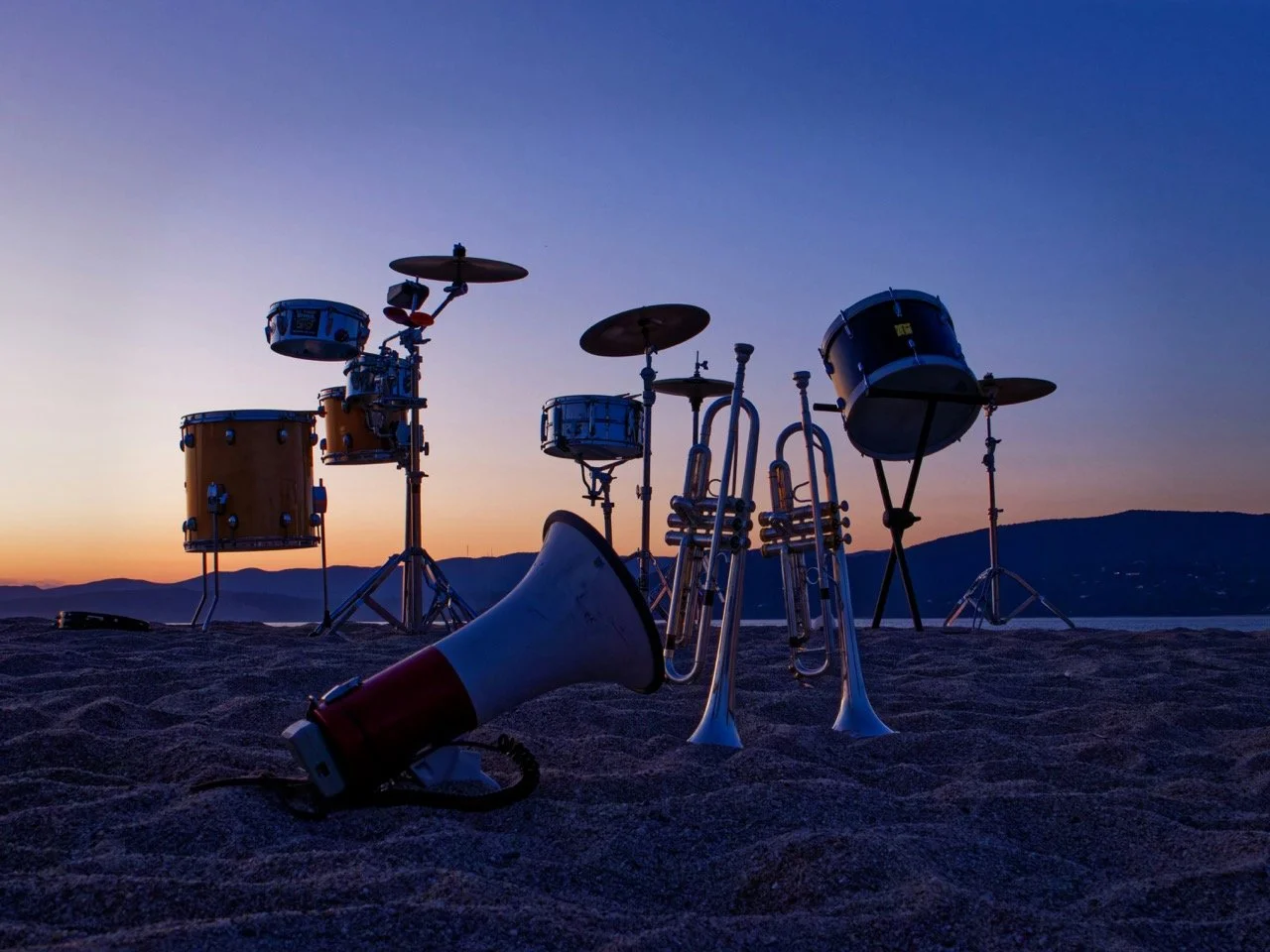
Motivation fades. Context stays.
A supportive context that keeps inviting you to show up turns music from something you hope to do into something you actually do.
Why Accountability Works
Psychology and habit research show that social accountability dramatically increases motivation and follow-through. When people know someone is aware of their goals, they are more likely to stick with them.
HABIT FORMATION Studies indicate that habit formation improves with consistent repetition [1]. Sharing goals in a group or with a partner can help maintain this consistency, thereby creating a context supporting stronger habit retention.
PEER FEEDBACK Research in education and skill learning shows that peer review and collaborative feedback improve performance and skill retention compared to solo practice [2].
But this priciple isn’t news.
Throughout history, creative communities have been the engine of artistic growth. Musicians didn’t become great in isolation — they thrived because they shared ideas, challenged each other, and learned in dialogue with peers.
Take The Beatles, for example. Lennon, McCartney, Harrison, and Starr weren’t just talented individually — their constant collaboration, riff-sharing, and playful experimentation pushed them to invent new sounds and arrangements. Their creativity emerged in the space between them, fueled by mutual accountability: each band member’s contributions shaped and challenged the others, driving innovation.
Even in classical music, Mozart and Haydn relied on community structures. Mozart’s early compositions were performed in private salons, surrounded by musicians and patrons who gave him immediate feedback. He collaborated closely with his father and peers, exchanging ideas and refining his works through repeated performances. Haydn, similarly, led ensembles where he composed for musicians he knew well, hearing his music live, responding to their abilities, and adapting accordingly. These interactions weren’t optional — they were essential to learning, experimentation, and growth.
Or consider jazz collectives in the 1920s and 1930s, particularly during the Harlem Renaissance. Musicians like Duke Ellington and Louis Armstrong honed their craft in small ensembles, jam sessions, and informal workshops. Each performance was a form of structured practice: riffs were tried, improvised, critiqued, and iterated on in real-time, creating a dynamic system of peer-driven accountability.
The takeaway? Great musicians don’t practice alone. They immerse themselves in communities that provide feedback, inspiration, and momentum. Accountability isn’t just a modern psychological principle — it’s a timeless driver of growth, shaping some of the most iconic music the world has ever known.
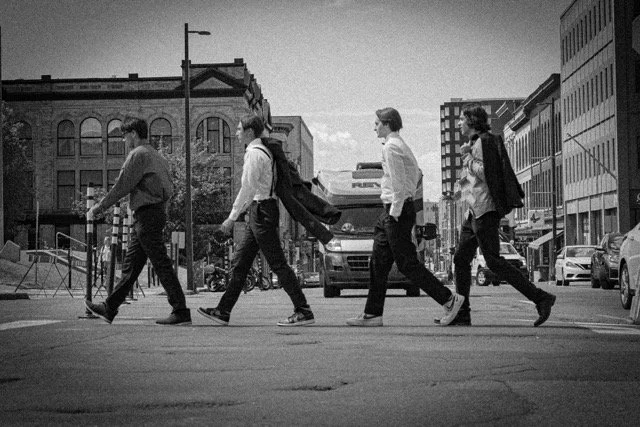
Isolation doesn’t make masters — community does.
How to Bring Accountability Into Your Practice
Consistency and growth aren’t just about showing up alone — they thrive when we involve others. Community provides feedback, inspiration, and gentle accountability, keeping your practice sustainable. Here are concrete ways to integrate it into your routine:
Involve others in your practice and projects.
Collaboration creates motivation and accountability. Being seen by others keeps you honest with your goals, and their feedback can reveal blind spots you wouldn’t notice on your own. This could mean:Singing in a choir or ensemble
Joining a band or collaborative music project
Taking regular lessons with a teacher or mentor
Hosting monthly living-room concerts for friends or family
Sharing compositions with a peer for feedback
Join a practice group or creative community.
This could be a local ensemble, an online forum, or a structured gathering like The Music Room. Communities provide a space to present your work, ask questions, exchange ideas, and receive encouragement — all of which fuel motivation and consistency. For many musicians, community is the missing link between effort and progress — if you feel stuck, shared practice and creative exchange might be exactly what unlocks your potential.Set clear weekly goals.
Define what you want to accomplish each week and share it with someone you trust — a teacher, peer, or community. Publicizing your intentions creates natural accountability and helps you stay on track.
Slow, deliberate, and consistent action — paired with the support of a community — produces far more growth than occasional bursts of overzealous practice. When you integrate peers, goals, and reflection into your routine, you’re not just practicing more effectively; you’re creating a sustainable, joyful path to mastery.

If you’re practicing alone and not moving forward, community might be the missing link:
Creative exchange has a way of activating growth that solo effort can’t.
ThE Role Of Music Communities
For most musicians, inconsistency isn’t a lack of talent or desire — it’s a lack of context. Creativity rarely thrives in isolation for long. Communities offer something many of us are missing when we try to do it all alone: structure, feedback, and momentum.
When you practice in isolation, everything stays internal. Ideas remain vague. Projects stretch on indefinitely. There’s no natural endpoint, no reason to finish, no mirror reflecting where you actually are. Over time, this can quietly drain motivation — not because you don’t care, but because nothing is anchoring your effort.
A supportive music community changes that dynamic.
Presenting your work makes the abstract concrete. When you know your song, exercise, or idea will be shared — even in an informal way — you’re far more likely to bring it to completion. The act of presenting creates a deadline and helps shift your identity from “someone who practices” to “someone who shares work.”
Receiving constructive feedback brings clarity. Supportive peers can hear patterns you’ve grown blind to, spot habits forming early, and offer perspectives that keep you from spiraling into self-criticism. Good feedback doesn’t judge — it helps you orient. It reminds you that you’re learning, not failing.
Celebrating small wins builds momentum. In community, progress doesn’t have to be dramatic to be real. A finished verse, a cleaner transition, a consistent week of practice — when these moments are witnessed and acknowledged, they reinforce your motivation to continue. Momentum grows from recognition, not pressure.
If none of this has convinced you to involve others in your practice yet, here’s a spoiler: Parkinson’s Law. When we work completely alone, creative projects have a talent for stretching themselves all the way to Sankt-Nimmerleins-Tag — that famous “one day” that never seems to show up.
Parkinson’s Law: Why Creative Work Takes Forever Without a Container
When we work entirely on our own, time has a strange way of stretching: Pieces stay unfinished. Songs live in drafts. Projects remain “almost there” for months — sometimes years. Not because we’re lazy or undisciplined, but because nothing is asking the work to arrive.
This phenomenon was first described by historian Cyril Northcote Parkinson in 1955 and later became known as Parkinson’s Law:
Work expands to fill the time available for its completion.
While the observation emerged from organizational studies, it describes something deeply familiar to creatives.
When there is no deadline, no witness, and no external moment of sharing, creative work doesn’t naturally conclude it keeps softening at the edges. There’s always one more tweak, one more version, one more day before it’s “ready.”
In music, this often shows up as:
endlessly refining the same piece without ever releasing it
postponing recording because it doesn’t sound “finished” yet
staying in preparation mode rather than presentation

Creative work doesn’t self-terminate.
Without a deadline or a witness, it keeps unfolding instead of finishing. Or in Parkinson’s words: “Work expands to fill the time available for its completion.”
Parkinson’s Law doesn’t mean that creativity should be rushed. It means that creative work needs a container. A moment where it gets to take form, even if imperfectly.
This is where communities play a quiet but powerful role.
When you know your work will be shared — in a band practice, a lesson, a music room, or even a small circle of peers — time compresses in a healthy way. The work begins to organize itself. Decisions get made. A song doesn’t need to be perfect; it needs to be presentable.
And that shift is transformative.
Instead of waiting for certainty, you work with what’s alive now. Instead of polishing endlessly, you practice completion. Instead of asking “Is this good enough?” you ask, “Can this be shared?” Over time, this changes your relationship to progress.
You learn that finishing is not a final verdict on your ability — it’s simply a moment in an ongoing conversation with your craft. The next version will come. The next piece will be better. But only if this one is allowed to exist.
Parkinson’s Law reminds us of something surprisingly gentle: Creative work doesn’t need more pressure.
It needs time boundaries, witnesses, and permission to land.
Communities provide exactly that — not by forcing output, but by giving your practice a place in time. And in that place, music finally has room to arrive.
Inspired?
Learn more about The Music Room
References
[1] Lally, P., van Jaarsveld, C. H. M., Potts, H. W. W., & Wardle, J. (2010). How are habits formed: Modelling habit formation in the real world. European Journal of Social Psychology, 40(6), 998–1009. https://doi.org/10.1002/ejsp.674
This study investigated how new habits form in everyday life by having 96 adult participants choose a behavior (e.g., eating, drinking, physical activity) and perform it daily in a consistent context (like after breakfast) for 12 weeks. Participants logged each day whether they did the behavior and completed a self‑report habit index measuring how automatic the behavior felt.
Key findings included:
Habit strength (automaticity) increased with repeated performance: as participants consistently repeated the behavior, it became more automatic.
The increase in automaticity followed a nonlinear (asymptotic) curve, rising quickly at first and then plateauing over time.
On average, participants reached about 95 % of their maximum automaticity around ~66 days of daily practice, though there was wide individual variation (range ~18–254 days).
Missing a single day did not significantly disrupt habit formation, suggesting consistency matters more than perfection.
What this means is that consistent repetition in the same context drives habit formation, and that forming a habit is not instantaneous — it tends to strengthen gradually as behaviors are repeatedly enacted until they become more automatic and require less conscious effort (i.e., less self‑control).
[2] Hattie, J., & Timperley, H. (2007). The power of feedback. Review of Educational Research, 77(1), 81–112. https://doi.org/10.3102/003465430298487
Hattie and Timperley conducted a conceptual review of existing research to examine how feedback influences learning and achievement. They found that feedback is one of the most powerful influences on student performance—but its effectiveness varies greatly depending on how, when, and what type of feedback is delivered. The authors proposed a model of feedback that distinguishes among different levels (task, process, self‑regulation, and self) and highlighted that feedback is most effective when it helps learners understand where they are going, how they are doing, and where to next. Their review clarified that feedback aimed at improving understanding and self‑regulation is more impactful than simple praise or evaluation alone.