Why So Many Musicians At First Hate the Sound of Their Own Voice
If you’re a musician and you don’t like the sound of your own voice, I hear you. You might assume something is wrong. Maybe you think your voice isn’t “good enough.” Maybe you assume you lack talent. Maybe you worry others hear something faulty in your voice, that you don’t. At least these are the beliefs that I carried with me way too long.
So here’s a truth for you that often comes as a relief: hating your own voice — especially at first — is incredibly common. Not just for small bloggers like me. Even some of the most famous singers in history have felt exactly the same way.
BONO: The U2 frontman has openly admitted he once cringed at the sound of his own voice on recordings [1].
JIMI HENDRIX & JOHN LENNON: Two rock-legends that also disliked how they sounded on tape, despite their iconic status [2].
MARY J, BLIGE: The Grammy‑winning singer has shared that for years she didn’t like the sound of her own voice until she learned to embrace it as part of her creative identity [3] .
If even some of the most celebrated voices in music history have struggled to listen to themselves, it raises an important question — one that goes far beyond whether your voice is objectively “good” or not. The real issue is how you relate to your voice.
This article will help you understand why hearing your own voice can feel uncomfortable, what’s happening psychologically and neurologically when self-criticism appears, and why vocal self-doubt often feels deeply personal. We’ll explore how the inner critic is often trying to protect you, how working with your voice can become a practice of self-acceptance, and why discomfort frequently shows up right when your growth begins. You’ll also find practical, experience-based tools to help you build confidence in your voice — step by step and without forcing artificial positivity.
If you currently feel stuck, embarrassed, or discouraged by the sound of your voice, this article is meant to offer clarity, relief, and a realistic path forward.
Before we dive in, it’s helpful to pause and explore where you currently stand in your relationship with your voice — because that starting point shapes everything that follows.

Ever felt like your voice just turned into a tiny dog yelping after you accidentally stepped on it? Yep…you’re in good company.
How Do You Relate to Your Voice? The “Voice Relationship Scale”
Before we dive deeper into this article, let’s take a moment to check in with yourself: how’s your relationship with your voice these days? Don’t worry — there’s no judgment here, just curiosity. I’ve found it helpful to think of this as a scale, a way to gently notice where you’re at and where you might like to move toward.
5 – “Avoid at All Costs”
Listening to your own voice feels unbearable. You cringe, you squirm, and if a recording comes on unexpectedly, you hide under the bed or pretend the Wi-Fi is broken. Shame and discomfort are real — and that’s okay. Your nervous system is just doing its job.
4 – “Akward introductions”
You still feel awkward or self-conscious when you hear your voice, but it doesn’t send you running anymore. You’ve made some peace with it — mostly by realizing everyone’s voice sounds weird to them at first. Bonus points if you can now play your own recordings without hiding your face behind a pillow.
3 – “Getting to Know You”
You don’t love your voice, but you don’t hate it either. You can tolerate recordings and maybe even notice some qualities that aren’t awful. Think of this stage as “meh, it exists and that’s fine”. The inner critic is still there, but you’ve put it on a leash.
2 – “Friendly Vibes”
You actually enjoy hearing yourself sometimes. You notice parts of your voice that feel authentic or expressive. Maybe there’s a tone you like, a color in your sound that feels uniquely yours. It’s like you’re starting to see your voice as a quirky, lovable friend rather than a frenemy.
1 – “Soulmate status”
You genuinely enjoy your voice. You love its texture, its quirks, its energy. You can hear yourself and think: “Yep, that’s me. No one else could ever sound exactly like that.” You feel a sense of pride and fun — maybe even imagining your voice as its own brand. And yes, sometimes you secretly sing in the car just for the joy of it.
As for me, if I’m honest, I’d place myself somewhere around a 2–3 on this scale. I don’t cringe when I hear my own voice anymore, and there are moments I genuinely enjoy listening to it — especially when I catch a phrase or tone that feels truly “me.” But I’m still on the journey: sometimes I notice old patterns of self-criticism creeping back in, or I hear a recording and think, “Hmm, could be better.” And that’s okay — the point isn’t perfection, it’s curiosity and patience with myself. My voice is still very much a work in progress, and part of the fun is noticing it evolve over time.

So… are we friends yet, or are we still in the ‘I hate you but I need you’ phase?
The Shock of Hearing Your Own Voice (Bone Conduction)
One of the most immediate reasons people dislike their recorded voice has nothing to do with quality and everything to do with how sound reaches your ears.
When you speak or sing, you hear your voice in two ways: through the air, like everyone else does, and through vibrations traveling directly through your bones and tissues. This internal transmission—called bone conduction—adds warmth and depth to how your voice sounds to you.
Recordings remove that internal layer. What you hear back is leaner, clearer, and often brighter. To your nervous system, this difference can feel alarming. The brain tends to interpret unfamiliar sensory input as something to be cautious about.
So the discomfort you feel when hearing your own voice isn’t because it’s “bad.” It’s because it’s .
And novelty, especially when it involves self-expression, often registers as threat before it registers as neutral.
The Inner Critic Is Trying to Protect You
Now that we’ve explored why your voice can sound so different to you than it does to others, it’s time to look at the psychological impact. When we hear something unfamiliar—something we’re not used to—our inner critic often springs into action with thoughts like:
My voice sounds embarrassing
I shouldn’t sing like this
People will notice my flaws
It’s easy to assume this inner voice is the enemy, wishing it would just be quiet. But in reality, it’s trying to protect you. Think of your inner critic as a “misguided protector.”
Why does it behave this way? Your brain is wired to prevent social rejection. Singing—being heard—puts you in a vulnerable position. It exposes not only your sound but also your emotion, identity, and presence. Your overenthusiastic and well meaning protector steps in to reduce risk, often with harsh language, hoping you’ll “fix” yourself before anyone else can judge you.
So when intrusive, self-critical thoughts arise while you sing, they aren’t inherently bad or something that needs to quieted. They’re simply your nervous system signaling that it’s trying to keep you safe. The problem only arises when we mistake these thoughts for truth, instead of recognizing them as fear speaking through the protective voice.

Friendship over friction: treat your inner critic as a protector and Guardian of your voice.
Reframe Your Inner Critic as Your Inner Protector
In my experience, one of the most powerful shifts musicians can make is changing how they relate to their inner critic. Instead of seeing it as an enemy, rename it your inner protector. This simple linguistic change shifts the relationship from confrontation to understanding, from fighting a critical voice to acknowledging its purpose in your system.
Each time your protector voices criticism or doubt, pause and ask:
“What are you actually trying to tell me?”
Most often, the answer is something like:
“I’m warning you your voice sounds squeaky because I want to protect you from being judged or hurt by others.”
Your protector isn’t trying to sabotage you—it’s trying to prevent potential emotional pain.
Engaging in curious, compassionate conversations with your protector over time can transform this relationship. The more your protector feels acknowledged and valued, the more you signal that you understand its well-meaning, though sometimes overly cautious, intentions. This awareness allows tension to release from your nervous system, making your voice freer and your performance less stressful.
My invitation is simple: instead of repressing or hating the inner protector, start relating to it. If you like, try seeing it as a well-intentioned friend, slightly overcautious, whose ultimate goal is to support you and help you thrive. By shifting from resistance to curiosity, you create a partnership that allows your voice—and your confidence—to flourish.

Building a relationship with your protector starts with gentle exposure:
Recording yourself and listening back while staying on the same team. Your protector isn’t there to judge — it’s there to guide you toward safety.
Why Disliking Your Voice Feels So Personal
Your voice is an instrument you were born with — one you cannot exchange, upgrade, or replace. Unlike a guitar, a piano, or even aspects of your appearance, the voice is uniquely tied to your body, your emotions, and your identity.
Almost any other part of our bodies can be altered: veneers for teeth, height adjustments, lasers for acne, even (scary) procedure to change the colors of the eyes permanently. But the voice? It is stubbornly, intimately yours. This is precisely what makes it such a powerful invitation to radical self-acceptance.
Disliking your guitar tone or feeling frustrated with a piano passage is one thing. Disliking your voice is something else entirely. It isn’t just a tool; it carries your history, your vulnerability, your emotions, and your very presence. When someone hears your voice, they are hearing you, not just the sound you produce.
That’s why self-doubt about your voice often feels heavier, sharper, and more personal than musical self-doubt. Criticizing your voice can feel like criticizing your personality, your sensitivity, or even your right to exist fully in the world. In this way, learning to accept your voice becomes more than a technical exercise — it’s a practice in broader self-acceptance.
I’ll be honest: this kind of self-acceptance can take time to develop.
Resistance to your own voice isn’t only about pitch, tone, or resonance. It’s about visibility. It’s about showing up in the world and claiming space. Every note you sing, every word you speak, becomes an act of courage. Accepting your voice means accepting yourself — and that’s a practice that extends far beyond music.
Therefore, music therapy often makes use of the voice as a direct pathway to self-acceptance and empowerment. Simple practices—like vocal improvisation, call-and-response exercises, or guided singing—invite participants to explore their sound without judgment. Nordoff‑Robbins music therapy for example, is a creative, improvisational approach that emphasizes active engagement in music‑making, including vocalization and improvisation, to support communication, self‑expression, and personal development. [4]
What does this mean for you, even outside a therapeutic setting? By intentionally occupying space with your voice, even in small ways, you can gently challenge feelings of shame or self-doubt and learn to feel safer in your own presence. Over time, small moments of claiming space with your voice — whether in the car, shower, or another safe setting — help cultivate not only technical confidence but also a deeper sense of personal agency: you’re reclaiming the right to be heard, to express yourself, and to occupy space in the world exactly as you are.
Why This Happens Especially at the Beginning
Ironically, this discomfort often shows up at the very moment you start to grow.
In the early stages of learning, awareness tends to develop faster than control. Your ear sharpens before your technique catches up. You begin to notice subtleties in tone, pitch, timing, and expression long before you’re able to shape them reliably with your voice. What you want to express becomes clearer, while your ability to execute it is still catching up. This creates a frustrating gap between intention and result.
This phase can feel brutal. Suddenly, you hear everything that isn’t quite working yet. The voice you once experienced from the inside now feels exposed, uneven, or disappointing when heard from the outside. Many musicians misinterpret this as regression or proof that they “aren’t cut out for it.”
But in reality, this stage is a hallmark of development.
You’re not failing — you’re perceiving more. You’re sensing nuance, contrast, and possibility. That heightened sensitivity is exactly what allows refinement to happen later. Without it, growth would plateau.
The risk here is avoidance: When the discomfort feels too intense, it’s tempting to stop recording yourself, stop singing, or mentally disengage. But stepping away during this phase can stall progress, not because you lack ability, but because the nervous system never gets the chance to adapt.
Staying gently present with the discomfort — without forcing, judging, or demanding perfection — allows your system to recalibrate. Over time, control catches up to awareness. The gap narrows. What once felt unbearable becomes familiar, then workable, and eventually expressive.
To help you move through this crucial phase with more ease, I’ll share a few practical approaches that have supported me during this exact stage.
In other words: this uncomfortable phase isn’t a sign that something is wrong. It’s a sign that something important is beginning to change.
Practical Tips That Helped Me Build Confidence in My Voice
(Exposure and skill-building, together)
For a really long time, I felt insecure about my voice. I constantly compared myself to friends who were fantastic singers—people who seemed completely at ease filling a room with sound. I wanted that kind of confidence for myself.
What helped me most was not one single technique, but a combination of exposure and confidence-building. Exposure helped my nervous system get used to being heard. Skill-building gave me a sense of agency and stability. Together, they slowly changed how I relate to my voice. Here is what looking back truly helped me. And the good news: Some of the most effective practices are entirely free.
EXPOSURE: GETTING USED TO HEARING YOUR OWN VOICE
1) Record your voice daily for 30 days - 0€
One of the most effective exercises I’ve ever done was recording myself every day for 30 days and listening back for just one to two minutes. Then I stopped. No analyzing. No judging.
All you need is the voice memo function on your phone.
This may sound simple, but repeated exposure is powerful: The more often you hear your own voice in a neutral, low-pressure context, the less threatening it feels. Over time, your system learns that hearing yourself sing does not lead to harm. This alone can significantly reduce vocal self-doubt. For me it did.
2) Record yourself with professional gear - 500€
If you’re serious about music in the long run, I highly recommend recording your voice with proper equipment at some point. For me, this was a real game changer.
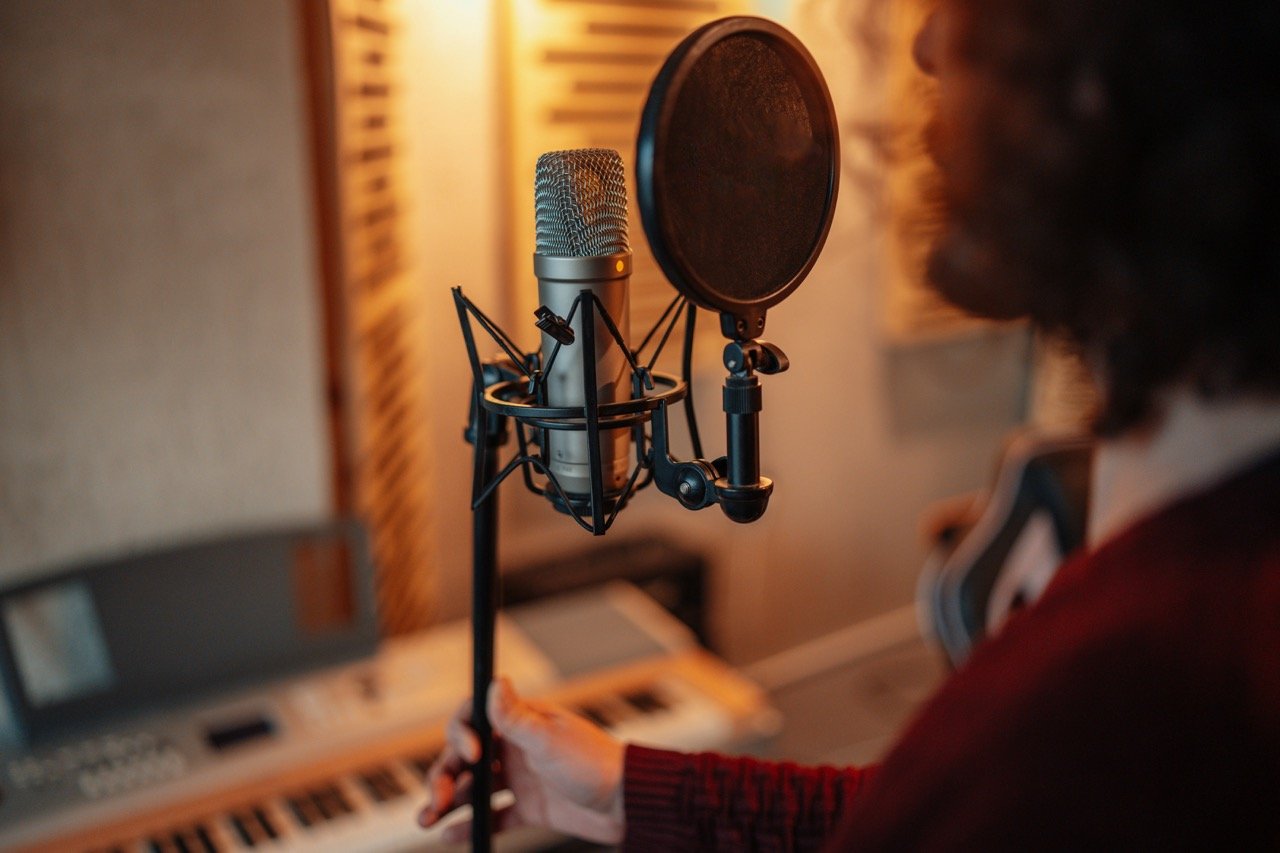
I use a Rode microphone, a Scarlett 2i2 audio interface, and studio headphones (I’ve provided a list of my gear below). This was an investment of around 500€, but it allowed me to hear my voice in the kind of quality I was unconsciously comparing myself to—professional recordings and artists online.
Hearing my voice with clarity helped me notice subtleties, warmth, and texture I had never perceived before. Instead of focusing on flaws, I started hearing character. This alone opened the door to much more self-appreciation.
A bonus: recording makes it easy to experiment. You can harmonize with your own voice, improvise over drones, or explore different textures. This kind of playful exploration is incredibly helpful when learning to trust your voice.
Bonus Tip) Add a Touch of Reverb
Most recording software allows you to add reverb to your voice. Think of it like singing in the gentle acoustics of a chapel rather than a small, carpeted room.
Reverb doesn’t actually make your voice louder, but it adds space, depth, and sustain. This often makes the voice feel fuller and more pleasant to listen to.
One reason recorded vocals can feel uncomfortable is that they’re usually very dry. In everyday life, we hear our voice within a space — reflected off walls, shaped by the room, and blended with natural resonance. When you listen to a dry recording, that spatial context is missing.
This ties back to the difference between bone conduction and air conduction. When we hear ourselves speak or sing, we experience more internal resonance and warmth. A dry recording strips much of that away. Adding reverb doesn’t recreate bone conduction, but it does restore a sense of space and smoothness that many people intuitively miss.
For many singers, this small adjustment can make listening back feel far less harsh — and far more familiar. For me it did magic for building vocal confidence. So if you decide on investing in some gear, give it a try. Reverb can be a supportive bridge when you’re learning to tolerate and eventually appreciate the sound of your own voice.
SKILL-BUILDING: CREATING SAFETY THROUGH COMPETENCE
3) Gentle vocal exercises you can do at home- 0€
To me this was one of the big game changers in my vocal journey: Starting with simple, but effective vocal exercise. You don’t need to spend money to start working with your voice. There are many free vocal training videos available online. Below, you can find a list of vocal exercises on YouTube I used.
Start gently. Ten to fifteen minutes every other day is enough in the beginning. Always put safety first—if your voice feels strained, warm, or stressed, stop!
Exercises like lip trills, soft humming, and gentle range exploration are especially helpful because they support vocal coordination without pressure.
4) Take a beginner-level vocal course - 99€
If you like structure, a beginner-friendly online vocal course can help you understand the basics of breath, tone, and vocal function. Look for courses that focus on foundations rather than performance or perfection.
Having a basic understanding of how the voice works can reduce fear and increase your confidence.
5) Work with a vocal teacher you feel safe with - 50€ per session
If you decide to work with a vocal coach, emotional safety matters as much as technical skill. Make sure you feel comfortable, respected, and not rushed.
I personally prefer in-person lessons because they feel more embodied, but online lessons can also work well. What matters most is the relationship and the sense of trust you feel.
Conclusion: From Rejection to Relationship
The goal isn’t to convince yourself that your voice is perfect.
The goal is to stop treating it as an enemy.
For most musicians, the journey isn’t from hatred to love—it’s from rejection to relationship. From bracing against the sound to letting it exist. From fear to familiarity.
If you dislike your voice right now, it doesn’t mean you’re doing something wrong. It may simply mean you’re at the threshold of being heard—by others and by yourself.
And that threshold, while uncomfortable, is where real artistic growth often begins.
Need More Support with Your Voice? Some Helpful Reads
What Can I Do If I Don’t Like How My Own Voice Sounds? 5 Tips
Alchemizing Self-Doubt: The Inner Growth Potential of Learning to Love Your Voice
Why Your Voice Changes When You’re Nervous (And How To Regain Control)
Overcoming Perfectionism in Music: Why Musical Growth Requires Courage, Not Just Skill
Bridging the Gap Between Taste and Skill as a Musician: How to Work Through Frustration
Free Warm Up Routines & Vocal Workouts on Youtube
These are all vocal workouts I practiced consistently over several weeks, mostly during my car drives, and I noticed a significant difference over time. I’m a soprano, so I’m only recommending exercises I’ve actually used myself and that suited my vocal range. If you have a lower voice, I encourage you to explore other videos and lessons from the same creators that are adapted to your range.
Please always put vocal safety first: stop immediately if your voice feels strained, painful, overly warm, or sore. I’m not a vocal coach or singing teacher — this is simply me sharing what genuinely helped me on my own journey.
A quick note: I’m a soprano. If your voice sits lower or higher than mine, you’ll want to find exercises that match your own range and feel comfortable for you.
Aussie Vocal Coach
Soprano Daily Vocal Exercises – Complete Vocal Range Workout for Power & Control
https://youtu.be/EgzczgWYw4k?si=sjVFv_ZlZuvYsThB
Soprano Vocal Warm Up for High Range – Improve Resonance, Power & Tone
https://youtu.be/81GfbeqSwYg?si=fS_8BFr53OaKZLyH
COMPLETE Daily Vocal Routine for Sopranos
https://youtu.be/yjYYCypcSVA?si=hIRHUlPLUHmwtwQ6
Pentatonic Riffs and Runs – Daily Vocal Exercises | Master Smooth, Fast Melisma
https://www.youtube.com/watch?v=X4mmWbBt4gI
Advanced Riffs and Runs Vocal Workout – Female Riff Exercises for Speed & Precision
https://www.youtube.com/watch?v=UI0RjRCPR7c
Kathleen Hansen Music
Improve Your SINGING VOICE with these VOCAL WARMUPS and EXERCISES
https://www.youtube.com/watch?v=6ZjednQ_d_c
17 Minute Vocal Workout | Vocal Warmup
https://www.youtube.com/watch?v=uNurO_Pp72A
16 Minute VOCAL WARMUP for SINGERS | Best voice warm-up
https://www.youtube.com/watch?v=4F8PVLelXvs
Vocal Warmups and Vocal Exercises for High Voices | Tenor Soprano Baritone Mezzo Mezzo-Soprano
https://www.youtube.com/watch?v=q3nM5dMdKVs
Day 1: Vocal Re-Boot - Vocal warmups focus on BREATHING
https://www.youtube.com/watch?v=k47X8kmVWQs
Day 2: Vocal Re-Boot - Vocal warmups focus on PHONATION
https://www.youtube.com/watch?v=qfx8cS20BVQ
Day 3: Vocal Re-Boot - Vocal warmups VOWELS and RESONANCE
https://www.youtube.com/watch?v=DT2RTXTeIqw
Day 4: Vocal Re-Boot - Vocal warmups FLEXIBILITY and AGILITY
https://www.youtube.com/watch?v=64MApVGkSpU
Day 5: Vocal Re-Boot - Vocal warmups RANGE | sing higher with ease
https://www.youtube.com/watch?v=xncU-dcz7cg

Gear I Use
Microphone: Rode NT1-A, 180€
Audiointerface: Focusrite Scarlett 2i2 3rd Gen, 120€
Headphones: beyerdynamic DT-770 PRO/80 Ohm, 140€
Software: Ableton Live 12 Suite, 570€
If you are just starting out, but already know you want to record and produce your own songs, you can start with the Intro Version for 80€. This will definitely serve beginners, and give you nice options like adding reverb to your voice. You can later upgrade to Ableton Standard or Suite. I got my upgrade with a -30% discount in the week around Black Friday.
For all other cases I can recommend Garage Band which is a free software from Apple Users. You can easily add reverb to your voice in GarageBand on both Mac and iOS to create space and depth.
References
[1] https://gulfnews.com/friday/art-people/why-bono-and-many-other-rock-stars-hate-their-own-voice
[2] https://www.thethings.com/8-singers-who-dont-like-their-own-voice
[3] https://people.com/mary-j-blige-admits-she-used-to-hate-her-voice-8605328 Watch the interview with Mary J Bridge here. Scroll to time stamp 6:50 to hear her share about how she didn’t like her voice.
[4] Nordoff‑Robbins music therapy. (n.d.). In Britannica. Retrieved February 3, 2026 from https://www.britannica.com/topic/music-therapy/Approaches-in-music-therapy