The Myth of Perfect Music: Why AI Raises the Bar for Being Human, Not Lowering It
Is it just me — or are you being flooded too?
You open YouTube to watch one vocal warm-up, one songwriting interview, one live performance… and suddenly your screen fills with promises.
“Unlock Hollywood-level chord progressions instantly.”
“Turn your voice into a flawless pop star in seconds.”
“Switch from male to female vocals with one click.”
“Never hit a wrong note again.”
Magic chord generators.
AI vocal conversion apps.
Plugins that promise perfection without practice.
The message is subtle — but relentless:
Why struggle when you can sound flawless?
Why train when you can generate within a click?
Why be human when you can be optimized?
And if you’re a musician, singer, or songwriter, it hits somewhere tender.
Because part of you is curious.
And another part of you feels… replaced.
Suddenly your natural voice — with its cracks, breath, and unpredictability — can feel small next to algorithmic precision. Your messy demos feel amateur next to AI-generated “masterpieces.” The bar seems to rise overnight.
And maybe the real question beneath all those ads isn’t about technology.
It’s this:
What does it mean to be an artist in a world that can manufacture perfection on demand?

What if being human is the real work?
When polish becomes cheap, vulnerability becomes the differentiator.
At first glance, AI appears to democratize musical quality, offering beginners instant polish and the seductive satisfaction of sounding professional. But it hasn’t lowered the bar. It has quietly raised it — not technically, but psychologically.
Not because machines are better artists, but because algorithmic perfection amplifies an old fear many musicians already carry: the fear of being imperfect, exposed, or replaceable.
This article isn’t about whether AI can make “real” music. That debate misses the more important question. What matters is how living in a world of machine-generated perfection affects us — our confidence, our creative mindset, and our willingness to make and share work that is raw, unfinished, and human.
We’ll look at why perfection triggers self-doubt so strongly, how AI intensifies the inner critic, and why imperfection has quietly become one of the most important signals of authenticity in music today. Most importantly, we’ll explore what it actually takes to stay grounded as an artist in a time where “perfect” is cheap — and being human is the real work.
Because in an age of perfect music, being human is no longer the default. It’s the differentiator.
So let’s talk about what that really means for you — the one who has chosen, consciously or not, to follow the musician’s path.
What This Article Will Explore (And What You’ll Walk Away With)
This isn’t another debate about whether AI can make “real” music. That question misses the point.
What matters is what algorithmic perfection does to us.
In this article, …
We’ll unpack the illusion of perfect music — and why technical flawlessness is not the same as emotional meaning. You’ll see why cracks, breath, timing shifts, and strain aren’t flaws, but signals of presence.
We’ll explore why AI intensifies self-doubt in musicians, how it activates comparison, perfectionism, and performance anxiety — and why that response isn’t weakness, but a nervous system doing its job.
We’ll name the fear beneath perfectionism: the fear of sounding amateur, being replaceable, or not being enough. And we’ll clarify the real difference between an amateur and an artist in this new creative landscape.
Most importantly, we’ll redefine the bar.
Because when polish becomes cheap, courage becomes rare.
By the end, you’ll understand what actually differentiates human artists in the age of AI — not technical superiority, but psychological maturity. Not optimization, but embodiment. Not perfection, but the willingness to create anyway.
The future of music doesn’t belong to the flawless.
It belongs to the brave.

The Illusion of Perfect Music
When we talk about AI-generated music, the word “perfect” is often used — but it’s worth unpacking what that really means. In AI terms, perfection usually refers to technical flawlessness: pitch is stable, rhythms are exact, harmonies are consistent, and stylistic elements are coherent according to the algorithm’s training data. On the surface, it sounds polished, controlled, and — by conventional standards—“correct.”
Human music, by contrast, has always thrived in imperfection. From the subtle timing variations of jazz to the fragile vulnerability of a raw vocal take, music comes alive in the spaces where control falters and emotion takes over. Instability, unpredictability, even mistakes—they are the textures that communicate depth, risk, and authenticity. These micro-fluctuations create connection in ways a perfectly rendered AI track never can.
This distinction is subtle but essential:
Perfection is not the same as meaning.
Algorithmic precision can mimic the form of a song, but it cannot replicate the lived experience behind it – the struggle, the discovery, the tiny human flaws that give music soul. In a world increasingly flooded with AI-generated music, it’s these imperfect, emotionally resonant qualities that become the hallmark of human artistry.
Psychology: Why AI Makes Musicians Doubt Themselves
AI-generated music doesn’t just create technically perfect tracks — it also creates a psychological pressure cooker for human artists. When every song online can be instantly “polished” to algorithmic standards, our inner critic seizes the opportunity to compare, judge, and escalate self-doubt. Suddenly, it’s not just other musicians we measure ourselves against — it’s an endless flood of tracks that sound flawless, immediate, and omnipresent.
Why AI-Generated Music Triggers Self-Doubt in Musicians
This pressure taps into well-known psychological mechanisms that have been studied in social psychology and performance research. Social comparison bias refers to the human tendency to evaluate our own abilities relative to others, often perceiving ourselves as inferior when faced with perceived superiority — a pattern that becomes more intense when you’re constantly exposed to “perfect” AI-generated music online [1]. Social comparison theory suggests we don’t just see others’ skills objectively but judge ourselves against idealized standards, which can trigger feelings of inadequacy and self-criticism.
A related mechanism is the spotlight effect, the cognitive bias where people overestimate how much others notice them — especially their flaws [2]. When you listen back to your own recorded music and notice nuances that feel imperfect, your brain exaggerates their significance, making those imperfections feel far more visible — and threatening — than they actually are to listeners.
These comparison processes often intersect with performance anxiety — the fear of negative judgment or evaluation in a social or performance context. Research on music performance anxiety shows how evaluative pressure can heighten negative self-assessment, increased attention to potential mistakes, and self-focused attention, all of which amplify the inner critic and make exposure to others — or even to one’s own recordings — feel threatening rather than neutral or exploratory [3].
Importantly, these responses are not signs of weakness or lack of talent. They’re rooted in how human cognition and the nervous system evolved to protect us from potential social harm. When music creation is compared against a backdrop of algorithmic perfection, these psychological biases become activated more intensely, and what follows is not just self-criticism, but a nervous system response preparing for potential judgment — even when none is objectively present.
AI-Driven Self-Doubt Is a Nervous System Response
Here’s the critical insight: this response isn’t a personal flaw, a lack of talent, or weakness. It’s your nervous system doing what it’s wired to do: protect you from perceived social risk. Your inner critic, the same one that judges your pitch or rhythm, is responding to a new environment where imperfection is hyper-visible and comparison is constant.
Understanding this frames your self-doubt in a new light. It’s not about you failing — it’s about your system reacting to unprecedented pressures. Recognizing this allows you to work with your inner critic rather than against it, turning heightened comparison into a tool for growth rather than a trigger for shame.
This connects directly to what we’ve explored elsewhere: the inner critic, confidence in music creation, and strategies for transforming self-doubt into productive awareness. AI may raise the stakes, but it also clarifies where human artistry and emotional authenticity truly shine.
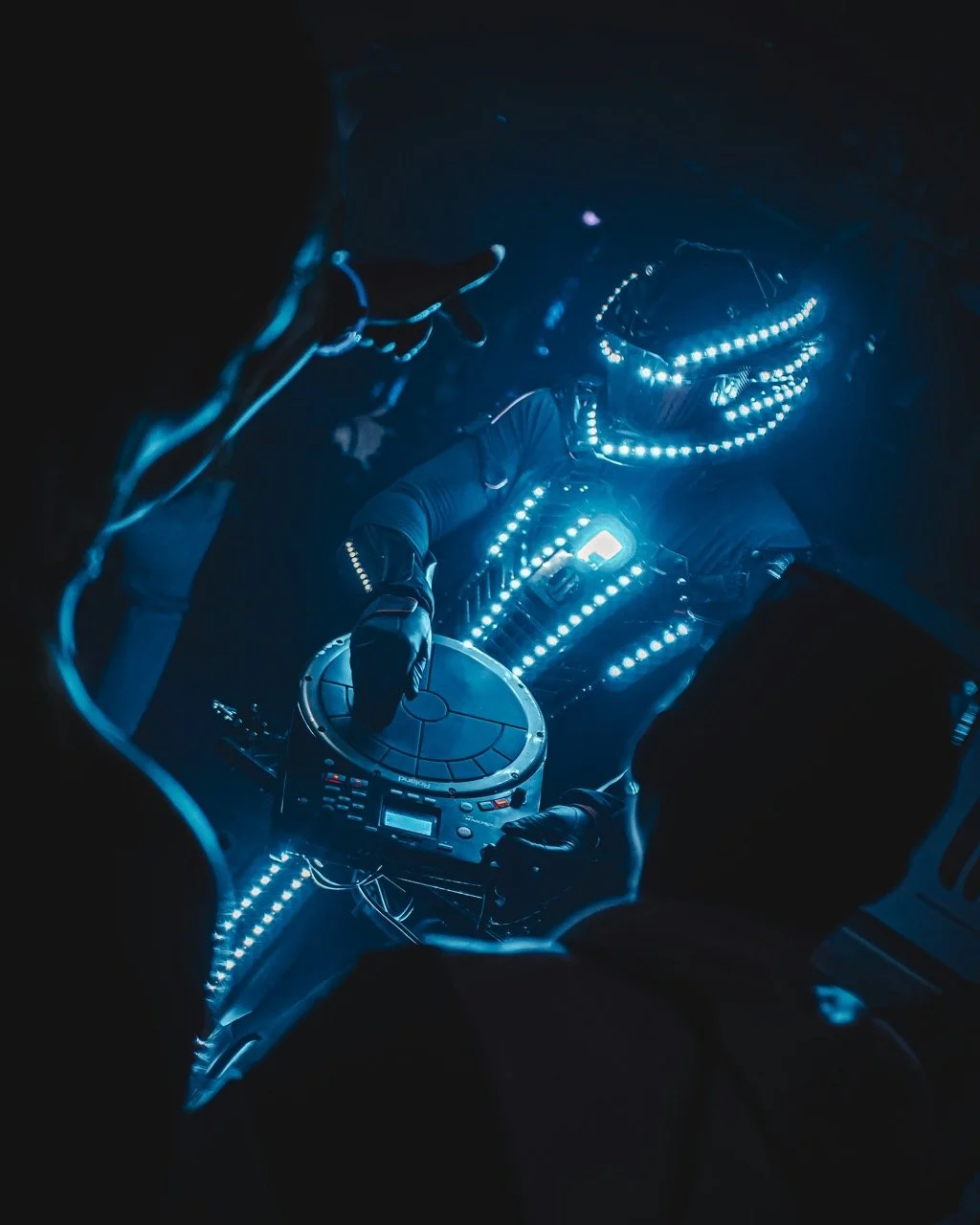
A perfect mind-f*ck: when your inner critic starts comparing your human music to AI perfection.
The Fear Beneath Perfectionism
Perfectionism in musicians isn’t always about loving excellence. Often, actually, it’s fear in disguise.
Beneath the urge to polish, refine, and delay, there’s usually something much more tender at work. A fear of sounding amateur. A fear of being exposed as replaceable.
A fear that if the music isn’t exceptional enough, then maybe we aren’t either.
In the age of AI-generated music, these fears are amplified. When algorithms can produce technically flawless tracks in seconds, it’s easy for musicians to internalize the idea that only perfection is worth sharing. Anything raw, unfinished, or uncertain can start to feel unsafe. This is where the fear of imperfection in musicians quietly turns into paralysis.
This is also where the difference between an amateur and an artist becomes visible. Amateurs tend to wait until they feel ready, confident, or protected from judgment. Artists, on the other hand, create while uncertain. They move forward without guarantees. They accept that being seen before feeling “finished” is part of the work.
Perfectionism promises safety, but it rarely delivers growth.
What actually moves an artist forward isn’t the absence of fear, but the willingness to create alongside it — knowing that uniqueness doesn’t come from flawlessness, but from presence, risk, and emotional truth.
Why Imperfection Feels More Human (and More Trustworthy)
There’s a reason imperfect music so often moves us more deeply than flawless sound.
Small cracks in the voice. Slight shifts in timing. An audible breath before a phrase. A moment of strain, softness, or instability. These elements don’t weaken a performance — they signal human presence. They tell us that a real person is here, taking a risk in real time.
These small imperfections are so important for music that AI is even mimicking them!
On a nervous-system level, listeners read these cues subconsciously. Imperfection tells the body: this is alive. There is effort, emotion, authorship. Someone is actually there, feeling something, shaping sound moment by moment. This is why imperfect music feels more human — and, paradoxically, more trustworthy.
Authenticity in music isn’t created through technical precision alone. It emerges when sound carries evidence of choice, vulnerability, and embodiment. A perfectly tuned, perfectly timed vocal may impress the intellect, but it rarely reaches the same emotional depth as a voice that trembles, breathes, or breaks slightly under feeling.
AI-generated music, by contrast, removes risk entirely.
It eliminates the possibility of failure — and with it, the possibility of meaning. There is no breath that could run out, no voice that could crack, no moment that could go wrong. The result may be smooth, coherent, and polished — but it is also sealed off from lived experience.
This is where the story flips.
Imperfection is no longer something to hide or overcome. It has become a signal of life. Proof that a human nervous system was involved.
Proof that the music came from a place of intention – not a dataset.
In a world increasingly saturated with algorithmic perfection, your inconsistencies, edges, and irregularities aren’t liabilities. They are the very things that allow listeners to feel you—and to trust what they hear.

AI Raises the Bar for Artists — Not Technically, But Internally
If AI raises the technical bar, it does something even more confronting: it raises the psychological bar.
Because when skill can be simulated, optimized, and automated, the question shifts. It’s no longer just ‘How good are you?’ It becomes:
Why are you creating in the first place?
AI forces artists into deeper territory. Into uncomfortable territory.
Why do you make music if perfection is cheap?
What part of your artistry cannot be automated?
How willing are you to be seen — not as flawless, but as human?
This is where the real differentiation happens.
Technical skill still matters, of course. Craft matters. Training matters. But in the age of AI-generated music, skill alone is no longer the defining edge.
What cannot be automated is courage: The willingness to show up before you feel ready. The decision to release something that carries fingerprints. The commitment to develop your voice over years, not days.
This is where process begins to matter more than performance.
Consistency. Depth. Long-term development. Not the quick result — the sustained relationship with your craft.
There’s something quietly powerful about choosing to build slowly in a culture obsessed with instant polish. About practicing when no one is watching. About refining your voice not because it will outperform an algorithm, but because it expresses something only you can shape over time.
Competing with AI on speed or surface-level perfection is a losing game. But competing on depth? On lived experience? On emotional authorship? That’s a different field entirely.
And stepping into that field requires psychological maturation.
It requires moving from “Is this good enough?”
to “Is this honest?”
From “How do I measure up?”
to “Am I willing to stand behind this?”
In this sense, AI doesn’t eliminate the human artist. It clarifies them.
The new bar isn’t skill.
It’s courage.

The real shift is No Longer from amateur to expert:
It’s from “Is this good enough?” to “Is this honest?”
AI doesn’t replace the artist. It reveals who’s willing to stand behind their work. The process is becoming more important than the performance.
What Actually Helps Musicians Right Now
If the goal is to compete with AI, here’s the secret: you don’t.
You can’t out-optimize a machine.
But you can outgrow it.
You can build a kind of artistry that no algorithm can replicate — the kind that lives in your body, your voice, your nervous system, your choices.
What helps isn’t faster perfection, it’s steady practice at being human in your music.
That means exposing yourself to creation — putting sound into the world, even if it’s raw, messy, or unfinished. It means tolerating imperfection, listening closely, and letting the cracks, breaths, and shifts in your voice carry meaning rather than anxiety. And it means staying in process, showing up repeatedly, even when confidence hasn’t yet arrived.
Here’s the key: confidence follows familiarity, not the other way around.
You don’t wait until you feel ready to record, perform, or share.
You create.
You expose.
You learn.
And over time, that repeated engagement builds resilience, trust in your own instincts, and an embodied sense of presence that no polished AI track can imitate.
In other words, the most powerful antidote to AI-induced self-doubt isn’t better technology — it’s presence. It’s practice. It’s being willing to inhabit your music fully, repeatedly, and fearlessly. It’s allowing yourself to be heard — imperfectly, courageously, and humanly.

Conclusion: The Future Belongs to the Brave, Not the Perfect
If there is one thing to take away from all of this, it’s simple:
You don’t need to out-perfect a machine to become a meaningful artist.
AI may be able to generate technically flawless music in seconds. It can optimize pitch, timing, style, and structure. But it cannot live a life. It cannot feel the hesitation before a lyric appears, the breath before a note, the tension between what you intended and what actually comes out.
And that tension — that human gap between intention and expression — is where art lives.
So if the rise of AI has made you feel like the bar has become impossibly high, here’s the relief: the bar was never perfection.
The real bar is presence.
Your willingness to show up with your real voice.
Your willingness to create before you feel ready.
Your willingness to let something imperfect exist in the world.
Because what listeners ultimately respond to isn’t flawless sound. It’s evidence of a person behind it — someone choosing, risking, shaping meaning out of experience.
In a world where perfect music can be generated instantly, courage becomes the rarest quality in art.
The courage to create.
The courage to share.
The courage to keep going when doubt appears.
So don’t wait until your music is flawless.
Write the messy song.
Record the imperfect take.
Follow the strange idea that won’t leave you alone.
Stay in the process. Stay curious. Stay human.
Because imperfection isn’t something you need to overcome on the path to artistry.
It’s the path itself.

The most powerful antidote to AI-induced self-doubt isn’t better technology — it’s presence.
Some Related Reads
What Is the Difference Between an Amateur and an Artist? (Hint: It’s Not Skill)
Why Your Voice Changes When You’re Nervous (And How To Regain Control)
The Great Slopification: Why the Future Belongs to Human Artists
References
[1] Social comparison bias. (n.d.). Wikipedia. Retrieved February 3, 2026, from https://en.wikipedia.org/wiki/Social_comparison_bias
[2] Spotlight effect. (n.d.). Wikipedia. Retrieved February 3, 2026, from https://en.wikipedia.org/wiki/Spotlight_effect
[3] MacAfee, A., & Comeau, D. (2025). Psychological predictors of music performance anxiety among vocal students: A gender-based SEM analysis. Frontiers in Psychology. Retrieved February 3, 2026, from https://www.frontiersin.org/journals/psychology/articles/10.3389/fpsyg.2025.1667730/full