Ed Sheeran’s Dirty Faucet Theory: Why Writing Bad Songs Is How You Write Good Ones
If you’re wondering how to write better songs, chances are you’ve already run into the most frustrating paradox of making music: you can hear what good sounds like — but what comes out of you often isn’t it.
That gap can feel discouraging, even humiliating at times. And yet, again and again, experienced musicians point to the same uncomfortable truth: bad songs are not a failure of the process — they are the process.
I was reminded of this recently while taking Dale McManus’ Ableton Live 11 for Beginners course, by Dale McManus. (By the way: This course wasn’t sponsored; I’ve paid for it myself.)
I signed up for this course for very practical reasons: Recently I started taking lessons in the music production software Ableton. Ableton is powerful and opens many creative possibilities, but for beginners — or anyone without a solid technical foundation — it can be overwhelming fast!
Dale breaks down the essential functions of the software, introduces a clear workflow for creating a track, and teaches useful habits along the way. But alongside the technical instruction, he also talks about something far more important: what actually works when you’re creating music. Not in theory, but in practice. And that’s where he brought up an analogy by Ed Sheeran that stopped me in my tracks.
Ed Sheeran’s dirty faucet analogy
Ed Sheeran compares songwriting to turning on an old, nasty faucet.
When you first open it, the water that comes out is brown, murky, and unpleasant. The key is …
… you don’t stand there judging the faucet.
… you don’t assume it’s broken forever.
… you simply understand: this is what needs to come out first.
Only after the dirty water has flowed out for a while does the clear water begin to run.
Songwriting works the same way.
The early songs. The awkward melodies. The cliché lyrics. The uninspired chord progressions. The tracks that make you cringe when you listen back — that’s the dirty water.
And crucially: you can’t skip it.
Because if you stop turning the faucet on because you’re ashamed of what’s coming out, the clean water never arrives.
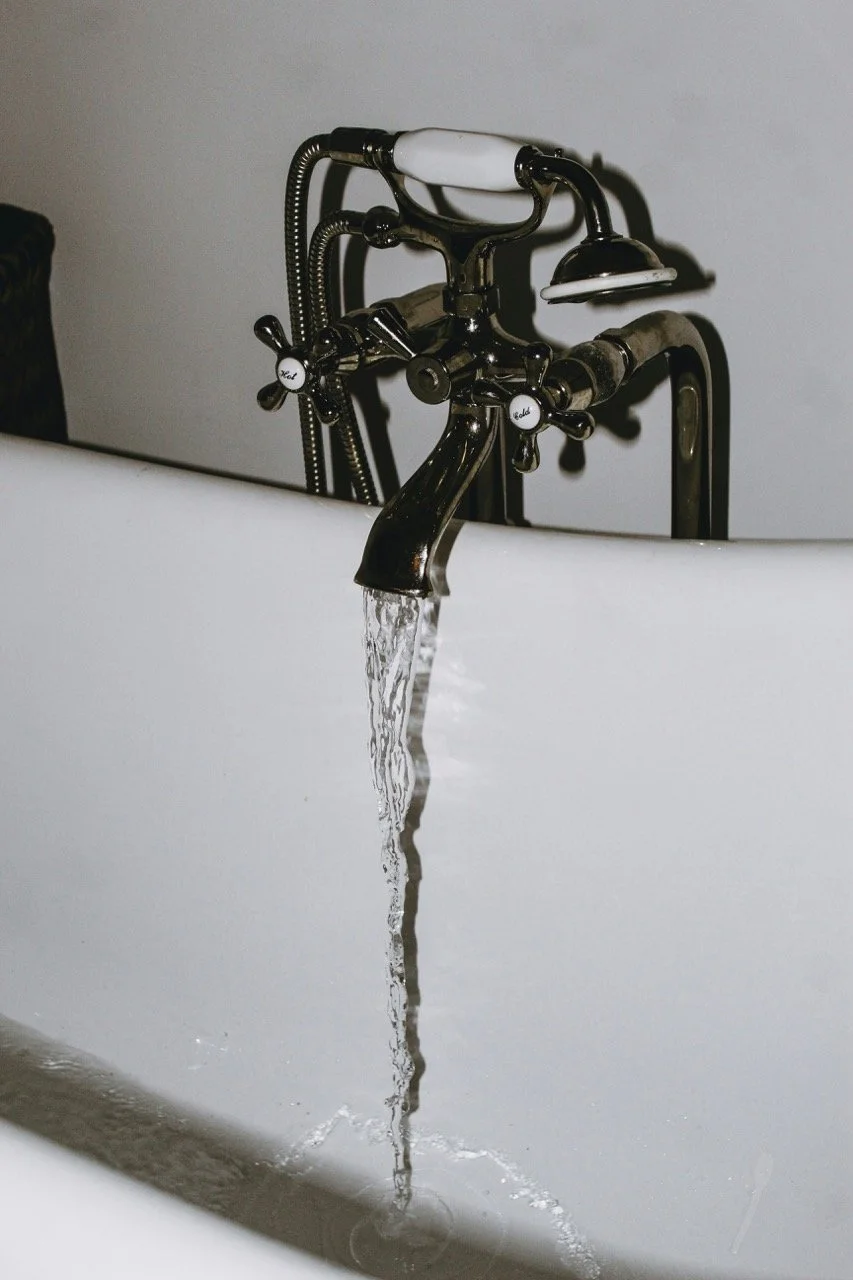
Let the Dirty Water Flow
If you stop turning the faucet on because you’re ashamed of what’s coming out, the clean water never arrives.
Hearing this analogy echoed something I’ve written about before. But hearing it articulated by Ed Sheeran — someone widely recognized for his songwriting craft — was a further confirmation: this is not a consolation prize for beginners. This is how it works for everyone.
The truth ist, almost every musician, whether at the very beginning or somewhere in the middle of their journey, encounters the same quiet struggle: the gap between taste and skill. I’ve covered this phenomenon extensively in Bridging the Gap Between Taste and Skill as A Musician, but here is the essence:
Our musical taste — what we love, admire, and feel deeply moved by — often develops much faster than our technical ability.
We can hear beauty, complexity, and nuance with great clarity, long before our hands, voice, or tools are able to translate that inner vision into sound. When what we create doesn’t yet match what we love, it can feel frustrating, discouraging, and even personal.
Yet this gap is not a sign that something is wrong — it is a natural and necessary phase of musical growth.
Skill takes time to catch up to taste, and it does so slowly, through repetition and patience. When we learn to recognize this phase for what it is, rather than fighting it or judging ourselves within it, it becomes far more manageable.
With a mindful approach, this in-between stage can transform from a source of self-doubt into a period of steady learning, resilience, and renewed inspiration. Every practice session and every song you create, to borrow Ed Sheeran’s analogy, is turning on the faucet.
No matter how imperfect what comes out feels, this murky water, is quietly moving you closer to the music you hear inside.
You have to make BAD music to make good music
Dale McManus sums it up plainly: “You have to make bad music in order to make good music.”
Or, as Ira Glass famously put it:
“Your taste is good enough that you can tell that what you’re making is kind of a disappointment… It’s only by going through a volume of work that you will close that gap.”
In essence: through making bad music, you learn what works and what doesn’t.
Each “failed” song is actually data.
Information.
A refinement of taste.
A muscle being trained.
Ira Glass
“Your taste is good enough that you can tell that what you’re making is kind of a disappointment… It’s only by going through a volume of work that you will close that gap.”
Why this matters if you want to write better songs
Here’s the part I think often gets missed.
The goal isn’t to tolerate bad songs while waiting for the good ones to arrive.
The goal is to change your relationship to the process.
When you stop interpreting early, imperfect work as proof of inadequacy, something important happens:
You create more.
You finish more.
You experiment more freely.
You build trust in yourself.
And that’s when quality actually starts to emerge.
This is especially relevant if you’re learning music production or songwriting on your own. Without external structure, it’s easy to assume you’re “doing it wrong” simply because the results aren’t immediately satisfying.
They’re not supposed to be.
(If you feel like you could use some support in moving through these limiting beliefs check out my free Musicians Guide to Embracing Imperfection – no silly email sign up necessary. Free to use on the spot.)
What helped me move through this phase
Two things have been particularly supportive for me lately.
1. Taking beginner courses — unapologetically
Courses like Dale McManus’ Ableton Live 11 for Beginners help me understand the fundamentals: how music software works, how tracks are structured, how ideas move from concept to form.
This removes unnecessary friction. Instead of fighting the tool, I can focus on the music.
2. Allowing myself to make “bad” work on purpose
When I consciously accept that early output is meant to be messy, something relaxes in my nervous system. I’m no longer trying to prove anything. I’m practicing.
That shift alone has made my creative process more sustainable — and paradoxically, more joyful.
Clear water doesn’t come from avoiding the mess.
It comes from moving through it.
The real takeaway
If you’re asking yourself how to write better songs, the answer may be less about finding the perfect technique and more about giving yourself permission to stay with the faucet long enough.
Let the dirty water run.
Don’t moralize it.
Don’t dramatize it.
Just keep showing up.
Clear water doesn’t come from avoiding the mess.
It comes from moving through it.
And that’s not a flaw in the process — that is the process.
P.S. I made this for you
If you feel like you could use some gentle support in moving through limiting beliefs around your music, you’re welcome to explore my free Musician’s Guide to Embracing Imperfection. There’s no email sign-up and nothing to commit to — it’s simply there for you to use, right when you need it.
I created this guide because, at the beginning of my own journey, I often wished someone would speak openly about what it’s really like to sit with the harsh inner dialogue that can arise when we create. I longed for reassurance that it’s okay to make messy, “shitty” music — and that perfection isn’t the goal. Self-kindness, curiosity, and creative play are.
We all face moments of doubt. What has helped me again and again is letting go of the need to get it right, and returning to the simple act of making music. This guide is an offering from that place. I don’t present myself as a finished or flawless musician, but as someone walking the path honestly, sharing what I’ve learned in the hope that it supports you in continuing yours — and in alchemizing life experience into sound. To me, that’s the true transformative power of music.