50 Hours of Focused Practice in 3 Weeks: What It Actually Feels Like
A raw, honest account of what happened when I stopped dabbling and started treating music like the profession I want it to be.
This Is What 50 Hours Looks Like From the Inside
I've written about the goal. The 700-hour commitment. The math, the structure, the vision of who I want to become as a musician.
Now I want to tell you what it actually feels like to be three weeks in, with 50 hours behind me.
Not the polished version. The real one.
The version with the 10-minute day when life got loud. The version with mental fatigue hitting hard at hour two of practicing. The version where I sat at the accordion and thought: is this actually working? The version where, despite all of that, I kept showing up — and started to notice things changing.
This article is a progress report, a reflection, and — I hope — something useful for anyone who is thinking about making a serious commitment to their instrument. Whether you're considering your own intensive practice period, or just trying to understand what consistent practice really produces, here's what I've learned so far.

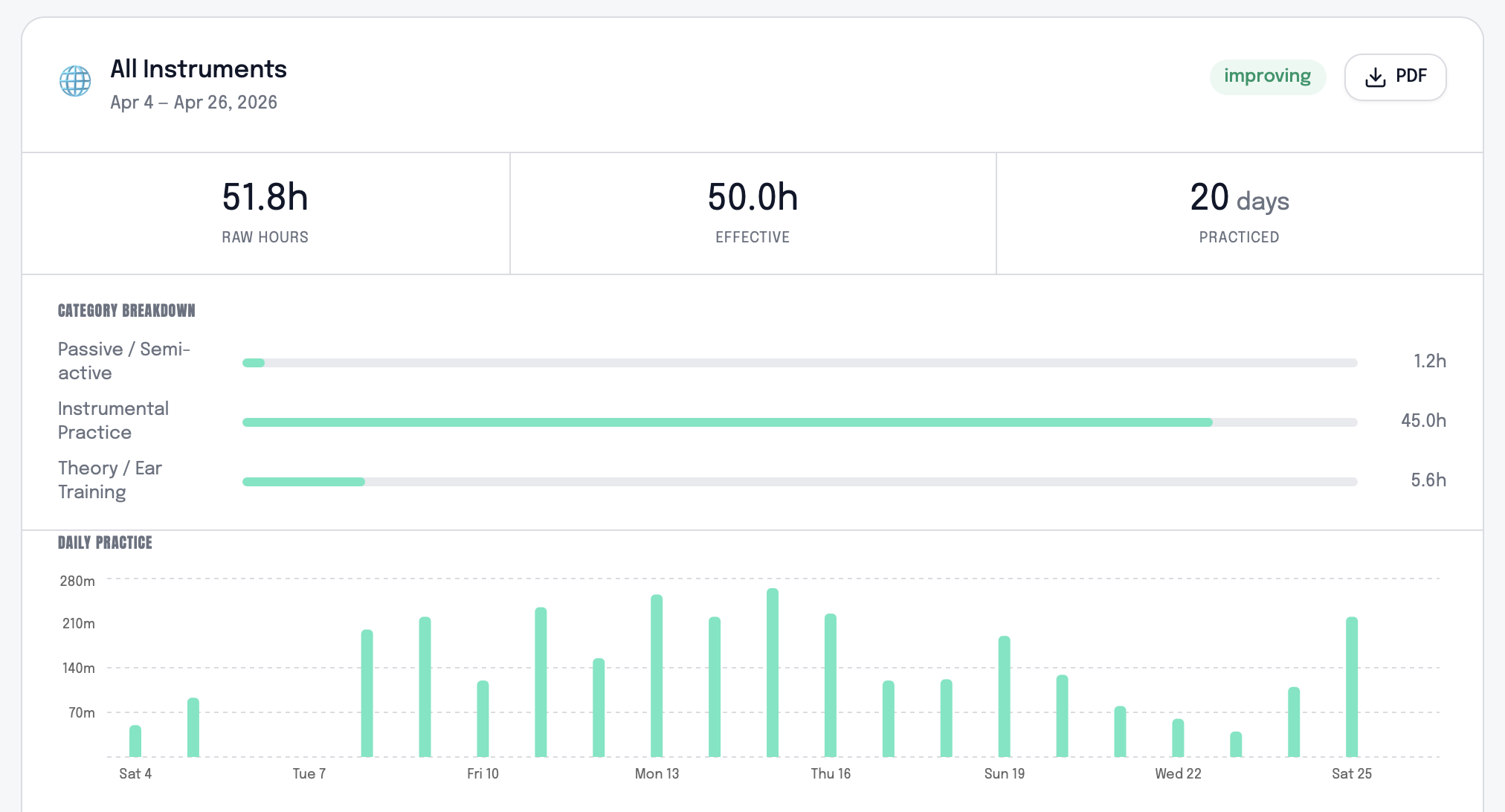
50h of practice in 3 weeks
The Setup: Three Instruments, One Clear Hierarchy
Three instruments. But not three equal priorities — that's the key.
The accordion is my primary focus. That's where the structured work lives: the technique, the repertoire, the deliberate, sometimes frustrating deep practice. Everything else orbits around it.
The piano came in through the back door, as a theory tool. When I'm trying to understand a chord progression or internalize a harmonic relationship, the accordion's button layout doesn't help — the logic is hidden in the mechanics. The piano makes everything visual. Keys, intervals, chord shapes — it's all laid out in front of you. Playing both instruments has accelerated my music theory comprehension more than either one would have done alone.
The flute is there for a completely different reason: joy. No artistic vision, no targets, no pressure. Just the pleasure of playing a melody instrumen. On the days when the accordion feels like work, the flute reminds me why I started any of this.
What I didn't expect was how well this combination would work. I went in worried that splitting attention across three instruments would mean mediocre progress on all of them. What I've found instead is that switching between them prevents the kind of cognitive fatigue that comes from grinding on the same material for hours. Each transition is a reset — for the hands, and for the mind.
One instrument for depth. One for understanding. One for love.
|
The Instruments |
Why This works |
|---|---|
| Accordion — primary focus, structured study |
technique + repertoire depth |
| Piano — music theory made visible |
understanding harmony & keys visually
|
| Flute — for the joy of it |
keeps practice exciting, not mechanical
|
The Honest Reality: What 50 Hours in 3 Weeks Actually Costs
Let me be direct about something the practice literature often glosses over: intensive practice is genuinely hard. Not in a romantic, montage-worthy way. In a real, tiring, sometimes-frustrating way.
Here's what I've actually encountered:
The 20-Minute Session Limit
I can sustain focused, high-quality practice for a maximum of 20 minutes before needing a break. This is not a personal failing — it's neuroscience. New, complex motor learning and high cognitive load require recovery intervals to consolidate.
What this means practically: to accumulate 3 hours of actual practice, I need closer to 4.5 hours of total time, factoring in 5-10 minute breaks between sessions. If you're planning an intensive practice period and haven't accounted for this, your schedule is going to feel impossible.
The Cognitive Load Is Real
I came into this experiment having played each of these instruments for perhaps 20 hours maximum beforehand. Everything — fingering, technique, music theory, notation, rhythm — requires active cognitive processing. Nothing is automatic yet.
After around 120 minutes of accumulated practice in a day, I hit a wall. Mental fatigue that makes further quality practice not just difficult but counterproductive. I used to think "if I could just practice all day, I'd progress so fast." I now understand why professional musicians don't simply practice 8 hours a day — and why building to 4–5 hours of high-quality daily practice is itself a long-term achievement.
The Opportunity Cost Is Real Too
I'm a freelancer. The time I'm practicing is time I'm not billing. This is not abstract — it's a financial reality I have to actively manage and consciously choose, week after week.
I mention this not to complain but because it's part of the honest picture of what a serious practice commitment looks like outside a conservatory or full-time music program. Most of us are building this life around existing lives. That's not a disadvantage — it's a constraint worth naming and planning for.

A Humbling Realisation:
I always imagined that the main obstacle to serious practice was time. Now I understand it's capacity. The ability to sustain focused, high-quality practice for hours is a skill that develops gradually — just like the music itself. The professionals who practice 4–5 hours daily have built that capacity over years. I'm building mine now.
What Is Actually Working: 50 Hours of Honest Observations
Consistency Is Its Own Reward
There's a moment — I noticed it around week two — where the question of whether to practice stopped arising. The decision was already made. I show up, I open my journal, I know what I'm working on today because I wrote it down yesterday. The friction that used to precede every practice session has almost entirely dissolved.
This is what habit formation actually feels like from the inside. Not motivation. Not inspiration. Just the quiet absence of resistance.
The Journal Eliminates Decision Fatigue
One of the most practical things I've built into this practice is a simple journal habit: at the end of every session, I write a few notes about where I left off and what I want to focus on next time. This means I never sit down to practice without already knowing what I'm doing.
The cognitive overhead of deciding what to work on — which sounds small but adds up — is gone. I arrive with a plan. I execute it. I note what happened. This single habit has made my sessions measurably more efficient.
Data Makes Progress Visible
I track everything. I’m a real nerd, when it comes to data, excel sheets and analytics.
Session length, instrument, focus area, notes on what I worked on. I generate reports. I look at charts.
This might sound excessive to some musicians — but for me, it's been transformative. Progress in the early stages of learning is often invisible from the inside. You don't feel yourself getting better day by day. But when you can see 50 hours of consistent practice laid out visually, when you can see patterns in your session lengths, in your weak areas, in your streaks and breaks — the evidence of effort becomes real in a way that pure feeling can't provide.
The tool I've been using for this is Base 44 — an AI that allows you to build any app you can imagine. I created a customized practice app for my nerdy needs specifically to support this kind of structured, data-informed practice. I'll share more about it below.

What 50 Hours of Focused Practice Actually Produces
I want to be honest here. 50 hours is not a transformation. It is not mastery. It is not even intermediate level.
But it is something — and that something is more concrete than I expected.
After 50 hours of focused, structured practice across 3 weeks, here is what has genuinely changed:
Sight-reading has improved noticeably — notation that required me to spell out each note now registers more fluidly.
Basic music theory is beginning to click — I understand chord construction, intervals, and basic harmony in a way that was entirely absent before.
Motor skills are developing — transitions that required full conscious attention are starting to become more automatic.
I have a clearer sense of how to structure my own sessions — I've internalized what kinds of work produce what kinds of results.
What hasn't changed yet: I cannot play anything performance-ready. I am still firmly a beginner on all three instruments. The gap between where I am and where I want to be is large and visible.
But here's what I've learned about that gap: it's not discouraging when you're moving through it. It's only discouraging when you're standing still, looking at it.
The Tools Making This Possible
Structured Study Textbooks
I'm working through beginner textbooks with sheet music for each instrument — not YouTube tutorials, not random internet resources. Textbooks provide the kind of sequential, cumulative skill-building that self-directed learning tends to skip. There's a reason pedagogical traditions exist.
A 20-Drill Music Theory Protocol
I work through a set of 20 targeted drills covering music theory fundamentals — note recognition, basic harmony, chord construction. These are short, focused, and done consistently across sessions. Theory that felt abstract is becoming functional knowledge.
Practice Tracking App
I used Base 44 to create my own custom practice tracking app, to perfectly suit my needs. It logs sessions, tracks patterns, generates practice reports, and acts as a kind of external memory for my practice journal. Because everything has high cognitive load right now, having a tool that helps me remember where I left off and identify blind spots has been genuinely valuable.

The Bigger Picture: What This Experiment Is Really About
The 700-hour commitment is not really about 700 hours.
It's about answering a question I've been carrying for a long time: what happens if I actually show up for my music the way I've always wanted to? Not someday. Not when things calm down. Now.
50 hours in, the answer is beginning to form. And it's less dramatic — and more real — than I expected.
It doesn't look like rapid transformation. It looks like a practice session every morning before work. It looks like a journal entry that takes three minutes. It looks like the 10-minute day when life intervened, and the full session the next day anyway.
It looks like the slow, quiet accumulation of something that is genuinely mine.
I'm not going back to treating music as something that happens when I have time. I'm building the life where it's part of the time I always have.

I'm not going back to treating music as something that happens when I have time.
Frequently Asked Questions
How much can you realistically learn in 50 hours of instrument practice?
50 hours of focused, structured practice is enough to build a solid foundation: basic technique, introductory music theory, early sight-reading, and the beginnings of muscle memory. You will not be performance-ready, but the gap between absolute beginner and functional beginner closes meaningfully in this time.
Can you learn multiple instruments at the same time?
Yes — with intention. Practicing multiple instruments simultaneously can actually accelerate learning if each instrument serves a different purpose. For example, using piano to visualize music theory concepts while focusing technical development on a primary instrument like accordion or guitar is an effective approach. The key is maintaining a clear hierarchy: one primary instrument, others as complementary.
How long can you practice music in one session?
For most adult learners working with new, cognitively demanding material, 15–20 minutes of fully focused practice per session is the realistic ceiling before quality declines. Longer sessions are possible with breaks of 10–15 minutes between focused blocks. Total accumulated practice of 2–3 hours per day is achievable for most adults, with cognitive fatigue becoming a genuine limit beyond that.
Is it normal to feel mentally exhausted after music practice?
Completely normal — and actually a good sign. Learning a new instrument is a high cognitive-load activity: you're developing new motor pathways, processing notation, internalizing rhythm and harmony simultaneously. Mental fatigue after practice is evidence that real learning is happening. It also means rest and recovery are part of the practice, not failures of commitment.
How do you stay consistent with intensive music practice?
The most effective approach is to eliminate the daily decision of whether and what to practice. Write your plan at the end of each session for the next one. Track your practice visually so progress is concrete and visible. Build breaks and rest days into your schedule from the start. And lower the bar on hard days — a short, imperfect session is worth infinitely more than no session.
Does tracking music practice actually help?
Yes, significantly — especially in the early stages when progress is hard to feel. Logging sessions, tracking patterns, and reviewing reports makes invisible progress visible. It also reduces decision fatigue by providing continuity between sessions. When you can see 50 accumulated hours of practice laid out in data, the evidence of your effort becomes concrete and motivating in a way that subjective feeling alone cannot provide.

Lower the bar on hard days — a short, imperfect session is worth infinitely more than no session.
Follow This Journey — and Start Your Own
I'm publishing regular updates on this practice experiment: what's working, what's hard, what the data is showing, and what 300, 500, and eventually 700 hours actually produces.
If you want to follow from the inside — the real version, not the highlight reel — subscribe to the newsletter below.
And if you're ready to take your own practice seriously — with community, accountability, and a tool designed for exactly this kind of intentional work:
The Music Room is a small, intentional community for musicians building a serious practice. It meets biweekly online, stays capped at 10 people, and is built on the belief that consistency is easier in community than in isolation.
Ready to build your practice with support?
The Music Room is a space for musicians who want to show up for their craft — with community, structure, and a place that holds you accountable.